Bullish Flag Pattern
Learn about the Bullish Flag pattern – a powerful continuation signal, how to identify it and trade it effectively.
Mark · Trader & Founder, Social Forex
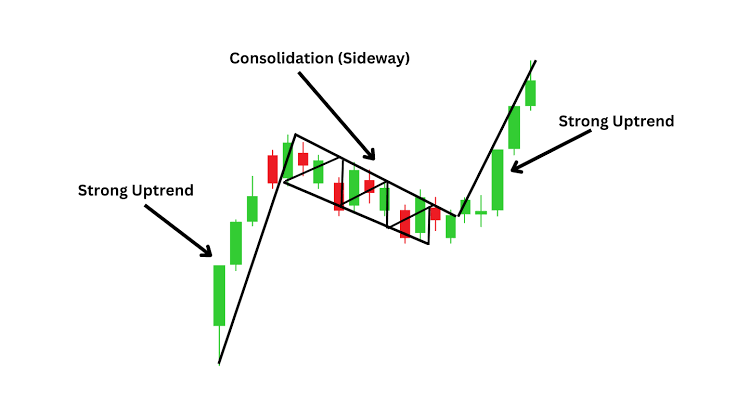
Definition
The Bullish Flag is a continuation pattern that occurs after a strong upward price move (the flagpole). It represents a pause before the trend resumes. The pattern consists of a flagpole – a steep rally with high volume – and a flag – a narrow consolidation channel that slopes downward or moves sideways on declining volume.
How to Identify
- A clear prior uptrend must be present.
- A sharp vertical rally (flagpole) forms on high volume.
- The price then retraces slightly within a parallel down-sloping or horizontal channel (the flag).
- Volume typically declines during the flag phase, indicating selling pressure is weak.
- A breakout above the upper trendline of the flag accompanied by a volume spike confirms the pattern.
How to Trade
Confirmation: Wait for a close above the flag's upper boundary with increasing volume. A strong bullish candle on the breakout is the entry signal.
Entry: Enter on the breakout close, or wait for a pullback to retest the former resistance as support (retest method).
Stop Loss: Place below the lowest low of the flag (the bottom of the consolidation).
Take Profit: Measure the height of the flagpole (from the start of the rally to its top) and add that distance to the breakout point. Example: flagpole = 100 pips, breakout at 1.2000, target = 1.2100.
Real Example
Imagine EUR/USD trends up from 1.1000 to 1.1200 over two days (flagpole). Then it pulls back to 1.1170 over three days, forming lower highs and lower lows – that is the flag. When price breaks above 1.1200 with volume, a trader goes long with stop at 1.1150 (below flag's low) and target at 1.1400 (200 pips flagpole height).
[diagram:generic-chart]
Common Mistakes
- Confusing the flag with a pennant – the pennant is a converging triangle, while the flag has parallel boundaries.
- Trading a breakout that lacks volume confirmation – low-volume breakouts often fail.
- Setting a stop loss too wide or too tight relative to the flag structure.
- Forgetting the pattern works best in strong trends; a weak trend may produce false flags.
Content is for reference only, not investment advice. Forex trading carries high risk.
Save your learning progress
Create an account to keep lessons, watchlist symbols, and journal notes connected as you practice.