Double Top Pattern - How to Identify and Trade
Learn the Double Top reversal pattern, how to spot it in an uptrend and trade the breakout for profits.
Mark · Trader & Founder, Social Forex
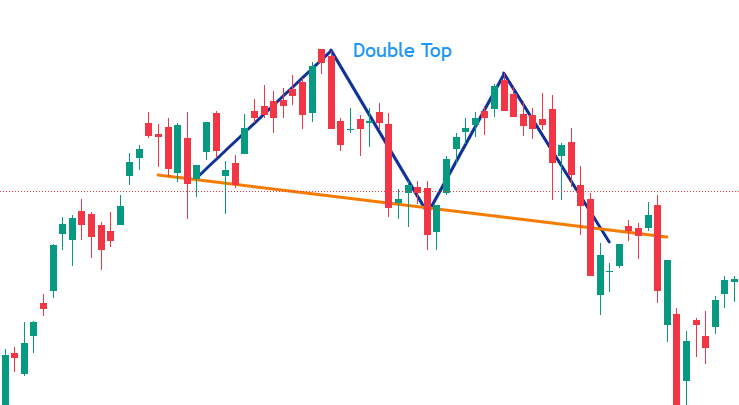
Double Top Definition
The Double Top is a bearish reversal pattern that forms after an uptrend. It consists of two roughly equal highs, creating an 'M' shape on the chart. Between the two peaks lies a trough known as the neckline.
How to Identify
- Prior trend: Must be a clear uptrend.
- First peak: Price rises to resistance, then pulls back.
- Neckline: The low point between the two peaks, acting as support.
- Second peak: Price rallies near the previous high but fails to break above, then declines.
- Volume: Typically declines, especially on the second peak, indicating weakening buying pressure.
See the diagram illustrating the pattern below:
How to Trade
- Entry: Short sell when price breaks below the neckline. Wait for a strong bearish candle as confirmation.
- Stop loss: Place just above the second peak.
- Take profit: Measure the distance from the neckline to the peaks, then project that distance downward from the neckline. For example, neckline at 100, peaks at 110 → difference 10 units → target at 90.
Real Example
In January 2023, EUR/USD formed a Double Top with peaks near 1.1050, neckline at 1.0950. After the neckline break, price fell 100 pips to 1.0850, matching the projected target.
Common Mistakes
- Confusing with consolidation: If the two highs are unclear, it might be a sideways range, not a reversal.
- Early entry: Wait for neckline break confirmation; don't sell prematurely.
- Ignoring volume: Low volume on the second peak is crucial; without it, the pattern is less reliable.
Practice identifying Double Top on H4 charts before trading live.
Content is for reference only, not investment advice. Forex trading carries high risk.
Save your learning progress
Create an account to keep lessons, watchlist symbols, and journal notes connected as you practice.