Market Structure Shift (MSS) Strategy
Advanced lesson on MSS: how to identify structural breaks and trade with smart money concepts.
Mark · Trader & Founder, Social Forex
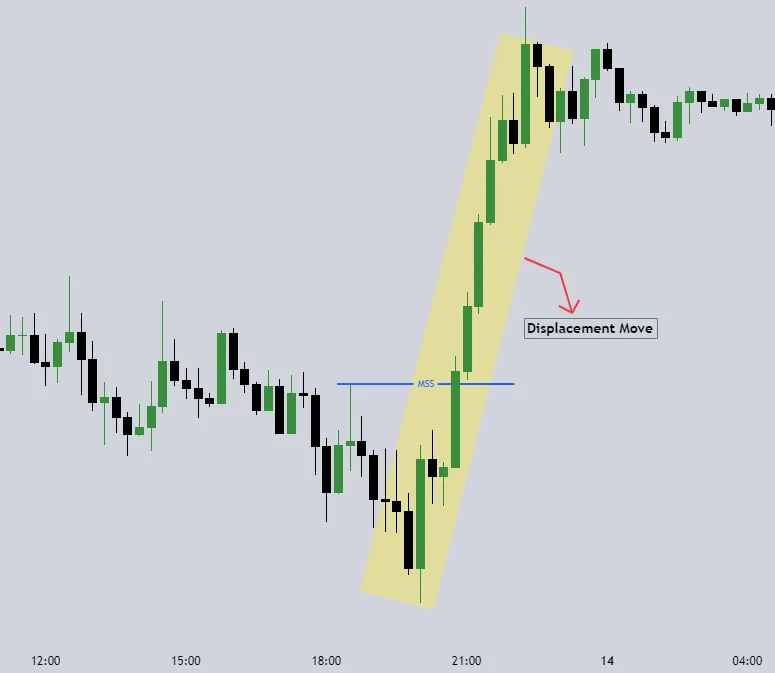
Definition of Market Structure Shift (MSS)
Market Structure Shift is a break of the current market structure, signaling a potential trend reversal. In SMC, when price breaks the nearest swing high/low and closes beyond it, it indicates MSS. Unlike Break of Structure (BOS) which continues the trend, MSS often occurs when the market transitions from uptrend to downtrend or vice versa.
How to Identify MSS
- Determine current structure: uptrend with higher highs (HH) and higher lows (HL), or downtrend with lower highs (LH) and lower lows (LL).
- Look for a break: price breaks a swing low (in uptrend) or swing high (in downtrend) and closes outside that level.
- Confirmation: strong reversal candles like engulfing or pin bar at the break zone.
How to Trade MSS
- Wait for a clear MSS signal on higher timeframe (H1+).
- Enter on retest of the broken level (former swing high/low) where Order Block or Fair Value Gap (FVG) often lies.
- Place stop loss below nearest low (for long) or above nearest high (for short).
- Take profit: minimum 1:2 risk-reward, extend to next structure.
Real Example
Assume USD/JPY H4 is in downtrend with lower highs. Price makes a new low then rallies breaking a recent high - a bullish MSS. Trader waits for retest, sees a bullish pin bar, enters buy. [diagram:choch-bullish]
Common Mistakes
- Confusing MSS with BOS: MSS changes direction, BOS continues trend.
- Entering too early without confirmation (e.g., only a small break then retrace).
- Ignoring higher timeframe: MSS on H1 might be noise on Daily.
Content is for reference only, not investment advice. Forex trading carries high risk.
Save your learning progress
Create an account to keep lessons, watchlist symbols, and journal notes connected as you practice.