Swing Failure Pattern: Trading Liquidity Sweeps with Candle Entries
Advanced lesson on the Swing Failure Pattern (SFP) – spotting liquidity traps and taking candle-based entries after false breaks of key swings.
Mark · Trader & Founder, Social Forex
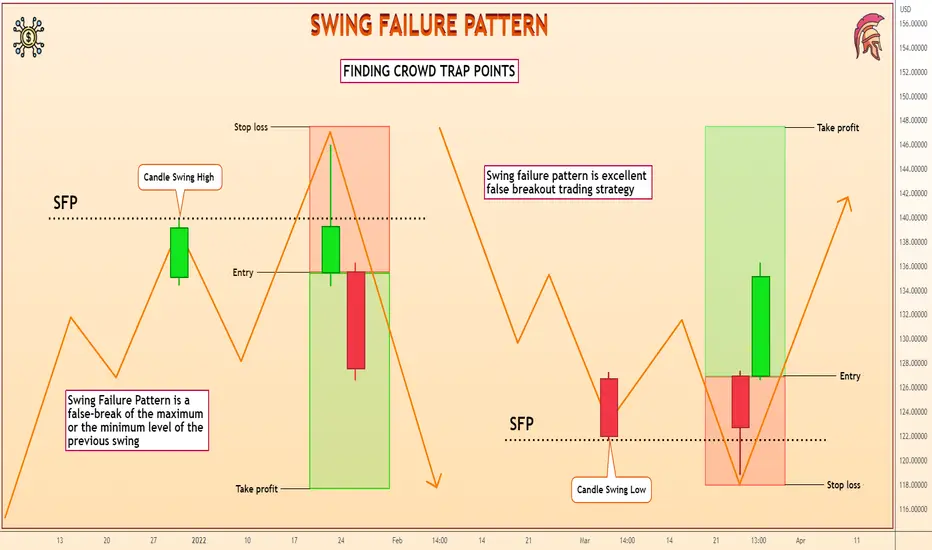
Definition
A Swing Failure Pattern (SFP) is a candlestick pattern that forms when price sweeps liquidity beyond a swing high or swing low and then closes back inside the pre-sweep range. In SMC, this false breakout shows that resting orders beyond the liquidity pool were absorbed, giving the opposing side control.
How to identify
- Find a recent swing high/low where retail stop losses are likely to cluster.
- Wait for price to wick beyond the level but fail to close beyond it.
- The signal completes when the sweeping candle closes back inside; strong signals often have a long wick or an engulfing body.
For a bearish SFP, the candle sweeping a swing high is often a bearish pin bar: a small body near the top, a lower wick longer than the upper wick, and a close back below the old high. [diagram:pin-bar-bearish]
For a bullish SFP, the candle sweeping a swing low is often a bullish pin bar: a small body near the bottom, a long upper wick, and a close back above the old low.
How to trade
- Locate the liquidity zone: a recent swing point or accumulation range.
- Wait for confirmation: let the SFP candle close completely; avoid live-entry before completion.
- Enter at the close or after a pullback to the breakout zone.
- Stop loss: above the swept high for a bearish SFP, below the swept low for a bullish SFP.
- Take profit: at the next liquidity pool, equilibrium, or before a potential reversal zone.
- Increase the odds by trading SFP at key supply/demand zones aligned with the higher-timeframe trend.
Real example
Price forms swing high A, drops to swing low B, then rallies and sweeps above A. The sweeping candle closes right back below A as a bearish engulfing candle that wraps the previous body – a powerful SFP variant. [diagram:engulfing-bearish]
Price then falls quickly toward B. Entering short after the confirming close with a stop loss above A provides a very strong risk-to-reward trade.
Common mistakes
- Early entries: buying/selling at the breakout, confusing SFP with a genuine BOS.
- Tight stops: not allowing enough room for wick volatility around the swept level.
- Ignoring context: SFP outside a major liquidity pool tends to fail.
- No candle close: acting before confirmation often results in getting stopped out before the reversal.
Content is for reference only, not investment advice. Forex trading carries high risk.
Save your learning progress
Create an account to keep lessons, watchlist symbols, and journal notes connected as you practice.